
If you own or manage a commercial building, the flat or low-slope roof over it is almost certainly a single-ply membrane, and the three names you’ll hear most are PVC, TPO, and EPDM. They look similar from the ground, but they perform very differently over a 20- to 30-year lifespan. Choosing the wrong one can mean premature leaks, higher energy bills, and a re-roof years before you should have needed it.
Here’s an honest, plain-English comparison of all three, and where each one actually makes sense.
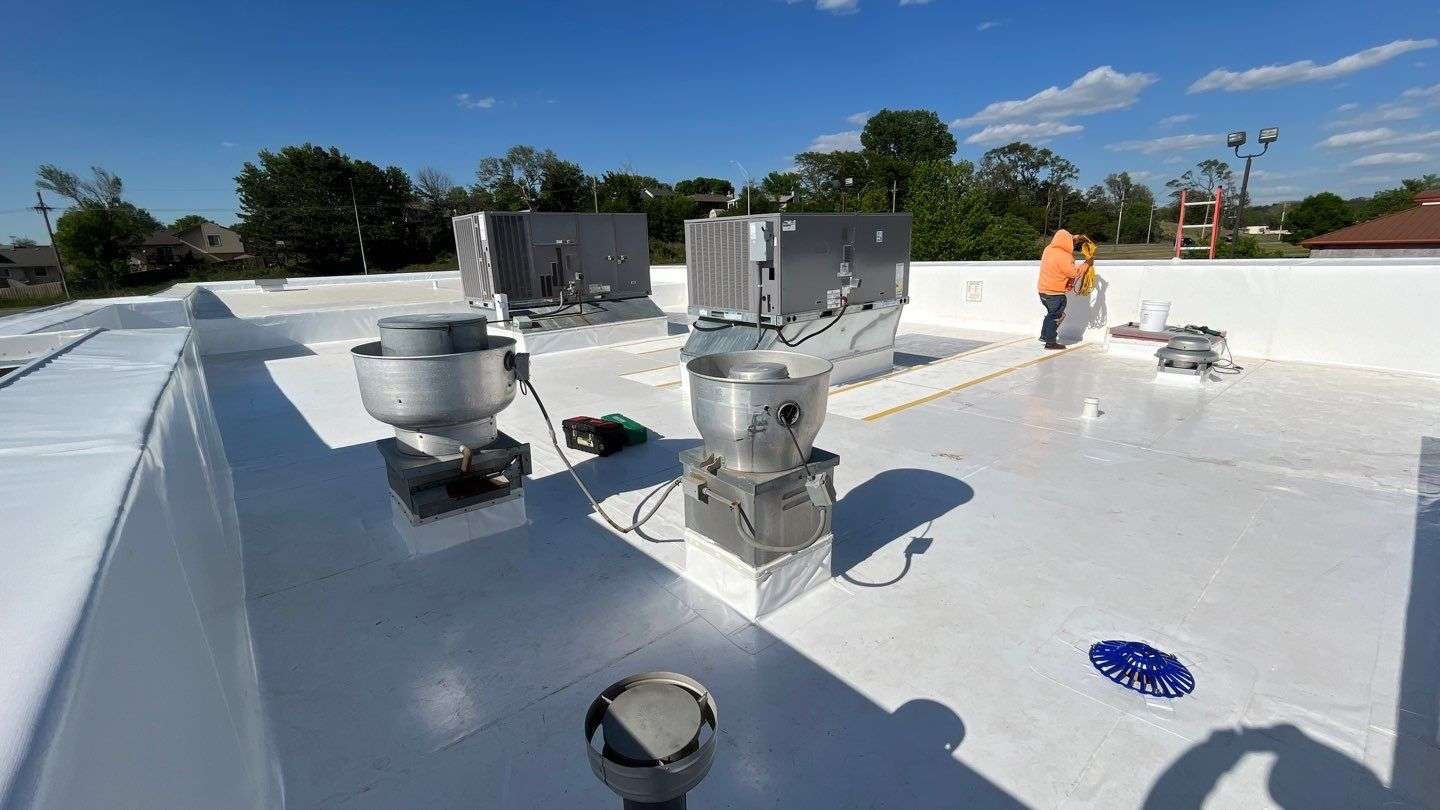
Ethylene propylene diene monomer (EPDM) is a synthetic rubber membrane that has been on commercial roofs for decades. It’s inexpensive, flexible in cold weather, and has a long, familiar track record. For a simple, budget-driven project, it can look attractive on paper.
The problem is how it ages. Traditional EPDM seams are glued or taped rather than welded, and those adhesive seams are the number one place these roofs leak as they get older. Standard EPDM is also black, so it soaks up heat and drives up summer cooling costs, and it offers poor resistance to oils, greases, and chemicals — a real issue for any building with rooftop kitchen exhaust or industrial discharge.
For those reasons, Ciaccio Roofing does not install EPDM. We’ve seen too many rubber roofs fail early at the seams, and we don’t believe it’s the right long-term investment for our customers when better systems exist at a comparable value.
Thermoplastic polyolefin (TPO) improved on EPDM in two important ways: it’s a white, reflective membrane that helps cut cooling costs, and its seams are heat-welded rather than glued, which makes them far stronger than an EPDM adhesive seam. It’s also generally the lowest-cost welded membrane, which is why it’s become so common.
The catch is consistency. TPO is a relatively younger product, and its chemical formulations have changed repeatedly across manufacturers and product generations. Some early formulations weathered and cracked sooner than promised, and quality can vary from one manufacturer to the next. TPO can be a reasonable choice — but the specific product and installer matter enormously.

Polyvinyl chloride (PVC) is the most proven of the three thermoplastic membranes, with the longest performance history. Like TPO, PVC seams are heat-welded into a single, monolithic surface, and it’s white and highly reflective for energy savings. Where PVC pulls ahead is durability and resistance: it stands up to grease, oils, chemicals, and ponding water far better than either EPDM or TPO, and it holds strong fire and wind performance.
The standout PVC system is Duro-Last, often called “The World’s Best Roof.” What sets Duro-Last apart is that each roof is custom-prefabricated to your building’s exact measurements in a controlled factory. Up to roughly 85% of the membrane’s seams are welded in the plant under ideal conditions, not on a windy, cold rooftop. That means dramatically fewer field seams (the place roofs leak), consistent quality every time, industry-leading warranties, and a fast, low-disruption installation over your operation.
Here’s how the three membranes stack up on the factors that decide how long a commercial roof lasts:
Factor | EPDM (Rubber) | TPO | PVC |
Material | Synthetic rubber | Thermoplastic polyolefin | Polyvinyl chloride |
Seams | Glued / taped — the common failure point | Heat-welded | Heat-welded; up to ~85% factory-welded |
Reflectivity | Black; absorbs heat | White; reflective | White; highly reflective / energy-efficient |
Chemical & grease resistance | Poor | Moderate | Excellent |
Consistency | Long track record | Formulations have varied over the years | Custom-prefabricated, factory-controlled |
Best for | Budget-driven, simple roofs | Cost-conscious commercial | Warehouses, long-term value, tough |
The honest answer: it depends on your building, your exposure, and how long you plan to own it, but the trade-offs point clearly in one direction.

As the largest Duro-Last contractor in Nebraska, Ciaccio Roofing matches the right system to the right building, and gives you a clear, honest evaluation with no pressure. If you’re weighing a repair or a re-roof for your Omaha-area commercial property, we’ll help you make the call with confidence.
Call us for an inspection: 402-513-0740 | ciaccioroofing.com
Call us for an inspection: 402-513-0740